
Paradox and Progress
Climate change vs Trump 2.0 and a new era of competition for resources


That we enter the new year confronted by challenging paradoxes, seemingly one after the other, reflects the complexity of the challenges that demand to be resolved. Paradoxes don’t get ‘solved’ in a traditional sense. They require deeper exploration and reflection, often via dialectical reasoning that can reveal a higher truth or a flaw in underlying assumptions. But this can create profound change, and progress.
In philosophy, Plato’s Socratic dialogues used questions to expose contradictions in beliefs, leading interlocutors toward greater clarity or understanding. Hegel’s ‘Phenomenology of Spirit’ applied a framework of thesis, antithesis and synthesis to describe how conflicting ideas evolve into more advanced understanding.
In energy, Albert Einstein (named Time magazine’s Person of the Century in 1999, a predecessor to Vladimir Putin in 2007 and Donald Trump in 2016 and 2024) reconciled the apparent paradox between Newtonian mechanics and Maxwell’s (no relation) equations of electromagnetism by introducing the theory of relativity. His theory of relativity showed that showed that mass (m) and energy (E) are interchangeable, which explained how a small amount of matter could be converted into a massive amount of energy, and vice versa. The proportionality constant is the speed of light squared (c2), a very large number (applied as the speed at which information and energy can travel), which explains why even a tiny amount mass can release an awesome amount of energy. This established a concept central to nuclear fission. This was applied with many consequences, some with the potential to endow the world with clean energy, others to enable weapons of mass destruction.
It was Einstein’s work on the photovoltaic effect that won him the Nobel Prize in physics in 1921 and that laid the theoretical foundation for modern solar technology. The Nobel Prize was a legacy bequeathed in the will of Alfred Nobel written in 1895 that directed his fortune to be used to create awards recognising achievements in science, literature and peace. But the legacy of the Nobel family is itself paradoxical, reflecting a dual narrative of destruction on the one hand with constructive contributions to human progress. In 1867 Alfred Nobel had invented dynamite. After his death, in the 1870s, his bothers, Ludvig and Robert, travelled to Baku, Azerbaijan, then part of the Russian Empire and the most recent host of the UN Climate Change Conference, COP29. The original purpose of the visit was to buy walnut wood, a key material for high-quality rifle stocks, for the family’s arms manufacturing business in Sweden. The brothers instead invested in local oil fields and became key to the development of the oil industry, introducing the world’s first oil tanker and then groundbreaking modern pipelines and storage methods. Oil played a transformative role in the shaping the progress of the 20th century, driving industrialisation, technology and geopolitics. But it also sowed seeds of challenges for the 21st century, including greenhouse gas emissions, environmental degradation, energy dependence and conflict that applies to our world today.
So far, 2025 has served up a parade of paradoxes.
2024 was the hottest year on record and, according to several agencies including Europe’s Copernicus, delivered temperatures that breached the 1.5C threshold above pre-industrial levels targeted by the Paris Agreement. Berkeley Earth showed that 2023 and 2024 were even hotter than the long-term trend since the 1970s for temperatures to increase in line with greenhouse gas emissions, boosted by El Niño amongst other factors. 2025, accompanied by La Niña may see a reduction in the rate of warming in the short term, but science will continue to evidence human-induced climate change.
And just as the new records are set, so the United States and some of the world’s largest financial institutions and companies are also set to roll back ESG and climate pledges. The incoming Trump administration is expected to withdraw from the Paris Agreement as one of its first orders of business. Climate-focussed groups such as Net Zero Asset Managers (which was actually suspended last week, taking with it the public listing of our own firm’s net zero target) and the Net Zero Banking Alliance have faced high profile withdrawals of members, particularly from the United States (and even most recently from Canada), ahead of Donald Trump‘s inauguration and in the face of conflicting political, legal and regulatory pressure not to conflate financial business with climate or environmental objectives. Some of the world’s largest investors such as Blackrock and Vanguard have faced lawsuits from Republican States led by Texas alleging breach of competition rules, as well as inquiries from federal bodies such as the FDIC asking whether they are adhering to regulatory requirements to act as passive investors in US banks. The political paradox here is that government regulations that have little or nothing to do with ESG can conflict with ESG objectives for banks and investors. Many of the world’s largest companies are simultaneously, at least outwardly, dumping ESG and DEI objectives. Meanwhile, measures by some regulators to clean up greenwash, for example through labelling rules introduced by the UK’s Financial Conduct Authority, are dissuading many investors from becoming officially ‘sustainable’ for fear of punitive action. Only around 10% of the 400 UK funds that claimed to be ESG had so far applied by for a green label according to Morningstar earlier this month. New reporting standards may also have an unintended consequence. The European Union is changing its classification requirement for banks, including its own, to the ‘Green Asset Ratio’, a feature of its sustainable finance rule book designed to identify how much of a bank’s assets are climate friendly. Because the proportion of green investments will appear significantly lower, the fear articulated by the EU’s own European Investment Bank is that this inadvertently risks the reputation of the many of the most sincerely committed parties, including itself.
Meanwhile, since the devastating Los Angeles wildfires engulfed the city, the attribution of cause to nature and climate change has been sharply juxtaposed with the human causes (some 95% of wildfires in Los Angeles are caused by human activity, accidental or intentional, including arson, utility line failures and equipment malfunctions), and recriminations for lack of government preparedness. Levels of reservoirs and fire hydrants, availability of water resources, maintenance backlogs, insufficient equipment and infrastructure and substandard vegetation management have all been identified as challenges and fuelled political flames. Donald Trump is reported to have attributed the fires to local environmental policies and forest management practices. But the broader context is that insurance industry is counting the cost of extreme weather and climate change globally. Wildfires in California have become more frequent and intense, attributed to prolonged droughts, high winds and climate change. This pattern has led to catastrophic losses for insurers. A recent example was the Camp Fire in November 2018 in Butte County, California, which destroyed 95% of the structures in the town of Paradise and killed 85 people. The fire was ignited by electrical transmission lines owned and operated by Pacific Gas and Electric Company (known as PG&E) and sparked its bankruptcy. Insurers paid out over US$25 billion from the 2017 and 2018 wildfire seasons. Fires, hurricanes and other disasters cost US$320 billion of damage in 2024 according to Munich Re, which appears to be up a third year on year, but which follows a longer-term pattern that has been evident for at least a decade. Several major insurance companies left the homeowner insurance market in high-risk areas of California in 2023 and 2024. This time, the Los Angeles wildfires are estimated to be the most expensive so far in United States history by an order of magnitude, with damages of up to US$135 to 150 billion.
What to do about it?
Just as Elon Musk, who claims to have done more for the environment that any other living being, reaches the epicentre of the United States political system alongside an incoming President labelled a climate denier, Tesla sales were reported this month to have fallen for the first time in a decade, while it’s Chinese competitor BYD continues to accelerate, drawing up neck and neck in the electric car sales race. Tesla and BYD enter the year going head-to-head for the international markets having won in their domestic markets, pitting technology and brand against price and vertical integration. The US government is expected to end the electric vehicle mandate and subsidies, while at the same time introducing punitive tariffs on international competitors. Musk though claims that Tesla can and should stand on its own two feet.
2024 was in many ways another record year for the global renewable energy industry. Solar went on a tear, with around 593GW expected to be added globally, up 29% year on year, with China contributing significantly to this growth. But many regional markets are now under pressure. The German solar markets are feeling the force of oversupply, market saturation and increased competition. European offshore wind markets in Europe became depressed; Denmark’s recent offshore wind tender concluded with no bids. High costs of capital and construction, particularly for offshore wind, together with any paring back of the Inflation Reduction Act, can also be expected to create headwinds in the United States for many utility scale projects.
In the UK, renewables hit new highs in 2024, but we enter 2025 with familiar and unwelcome challenges. Wind power became the UK’s largest electricity source for the first time in 2024, contributing 30% of generation, more than the 26.3% from gas. It supplied 68.3% of the UK’s electricity on December 18th. Renewable sources provided 45% of the UK’s electricity in 2024, the highest share to date, and the UK’s last coal-fired power plant was closed. However, electricity is still only 17% of the UK’s energy system. The new Labour government’s ambitions to make the UK a ‘clean energy superpower’ are colliding with the reality of time, cost and resources, while import dependency is going up rather than down. This week, fears of lack of availability for both the electricity and gas networks hit the news headlines, followed by denials from regulators. As the government hails AI as a driver of growth, it will need to grapple with the price and lack of availability of grid power that is making the UK challenging for the datacentre industry compared to its European neighbours. Solving this problem would be progress indeed.
But more energy generation and production worldwide, both renewable and fossil fuelled, is not translating into more energy security. Europe’s objectives to increase renewable energy and diversification of supply have been challenged since the Russian invasion of Ukraine. Russia turned the gas taps to Europe down (if not off) in the aftermath of the war. But on New Year’s Day, it was Ukraine that refused to extend a five-year transit deal for Russian gas to Europe, particularly hitting supplies to Slovakia, Austria, Hungary and Italy. While areas of global demand are under pressure, 2024 saw a surge in prices of gas prices of nearly 70% in Europe. Vladimir Putin put it like this in his December address: ‘you’ve made your bed, now lie in it’. In the United States, gas prices rose closer to 20% in 2024. The calls by the incoming Trump administration to ‘drill baby drill’ and to release export permits for LNG projects contrasted with efforts of the Biden administration to permanently ban drilling for oil and gas in targeted areas of federally owned waters of the United States. In the background, Ukraine received its first shipment of LNG from the United States, via Greece, on 27 December.
Looking ahead, Donald Trump has eyes on Greenland. The world’s largest island is geostrategic, particularly as climate change thaws Arctic ice (the Arctic has been warming three to four times faster than the rest of the world) and opens shipping lanes. It also holds significant potential for oil and gas as well as critical minerals (needed for the energy transition and other applications), including some of the world’s largest known deposits of rare earth elements (used in magnets, batteries and electronics), as well as significant deposits of graphite (used in batteries, fuel cells and electronics), titanium and vanadium (used in aerospace, defence and chemical industries), platinum (used in catalytic converters), aluminium and gallium (used in transport and construction), and molybdenum, niobium and tantalum (used in steel alloys, electronics and medical equipment). But it also serves as a gateway to the Arctic itself, which holds around 22% of the world’s proven natural gas reserves and potentially around 30% of the world’s undiscovered natural gas reserves.
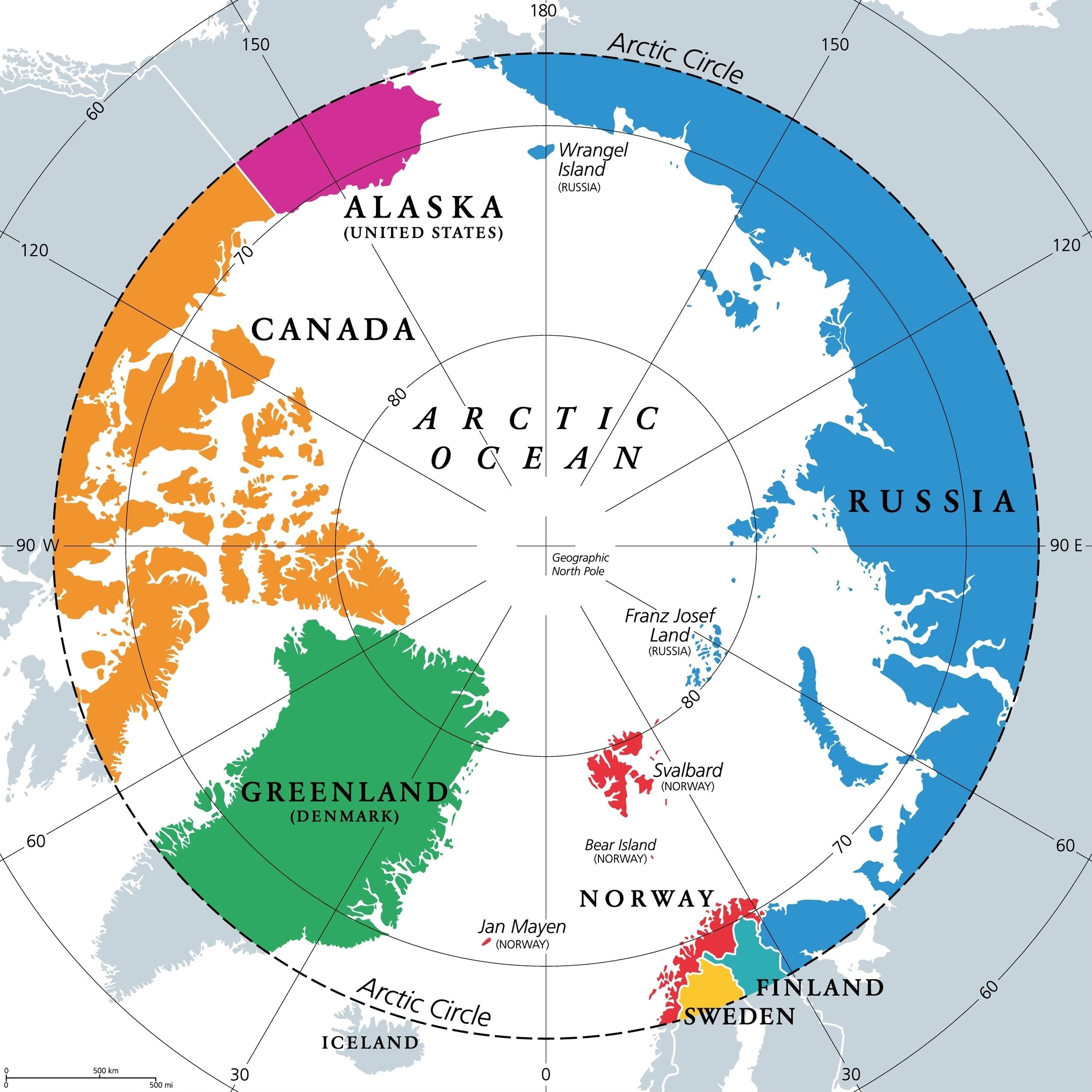
Chapter 1 of my book, ‘The Edge: How competition for resources is pushing the world, and its climate, to the brink, and what we can do about it’ starts in the Arctic. I pointed out that the United States of America (through Alaska), Canada, Denmark (through Greenland), Finland, Iceland, Norway, Sweden and Russia all have territory within the 16,000 km Arctic Circle. Even China claims to be a ‘near Arctic’ nation, claiming the same rights as Norway under the 1925 Treaty of Svaldbard. I told the story of Russia’s planting of a titanium flag on the seabed in August 2007 to ‘prove the North pole is an extension of the Russian landmass’. I told the story about the very first shipment of Russian liquified natural gas extracted from its Yamal facility in the Arctic, which was overseen personally by Vladmir Putin as it was loaded, and which landed at a terminal on the Mystic River in Boston, the United States. I also told the story about the opening of a shipping corridor in 2020 between Siberia and Alaska from the Bering Strait to the Barents Sea, a route controlled by Russia for which it charges a fee for passage, and which is used to protect its northeast coast. This prompted NATO to point out in 2021 that melting ice ‘could lead to new geopolitical tensions’. Military build-ups since have attested to this. But I didn’t tell the story of Alaska, which borders the Bering Strait, making it strategically important for national defence and Arctic policy. In addition to its endowment of minerals (including solid gold) and rare earths, has vast reserves of oil (Donald Trump’s ‘liquid gold’) and natural gas, particularly in the North Slope region and areas like the Arctic National Wildlife Refuge (ANWR). Alaska is thought to account for 15-20% of the United States technically recoverable oil reserves, of which ANWR represents 25-40%. Donald Trump is on it. In November 2024, he endorsed the long-planned Alaska LNG pipeline project and Alaska’s Governor has specifically requested the reversal of restrictions on oil and gas exploration in ANWR. Alaska is notably not connected to the United States’ ‘lower 48’. It was purchased from Russia in 1867.
So when Donald Trump postulates purchasing Greenland, annexing Canada or taking back control of the Panama Canal, it is instructive to consider historical context.
The setting for Donald Trump’s second inauguration was pushed inside for the first time in 40 years due to frigid temperatures. In his idiosyncratic fight with (if not against) climate change, the irony will not be lost on him. During the 2020 wildfires, when briefed on the role of climate change, he was reported to have responded: ‘It’ll start getting cooler … I don’t think science knows, actually’. (Interestingly enough, a weakening or collapse of the Atlantic Meridional Overturning Circulation (AMOC) slowing the Gulf Stream may indeed have a longer-term cooling effect, albeit because of climate change rather than because it’s not happening). Meanwhile, as the ice thaws in the Artic, a new arena for conflict over resources emerges, to which he is very much alert. If this dovetails with a degree of de-escalation in the Eastern Mediterranean and in Ukraine, if the United States’ tense relationship with China and Russia thaws (watch out for news on TikTok), and if the Trump 2.0 administration’s Department of Government Efficiency under Elon Musk turns to energy and reduces the enormous, egregious and unnecessary amount that is wasted while the world competes for it, then there might actually be some hopeful chance of progress …
Picture credits: ChatGPT 4o, Shutterstock
To buy a signed copy of The Edge, push this button:
The Edge is also available at Amazon and at bookshops.
To learn more about investing in energy efficiency, visit the website of the SDCL Energy Efficiency Income Trust plc, or SDCL Group.
Jonathan Maxwell’s Substack is a reader-supported publication. To receive new posts and support my work, consider becoming a free or paid subscriber.
Jonathan Maxwell’s Substack is a reader-supported publication. To receive new posts and support my work, consider becoming a free or paid subscriber.