
Iran, Resources, and the Next Act
Why the second act is more dangerous than the first — why Europe will feel it first — and what we can do about it.

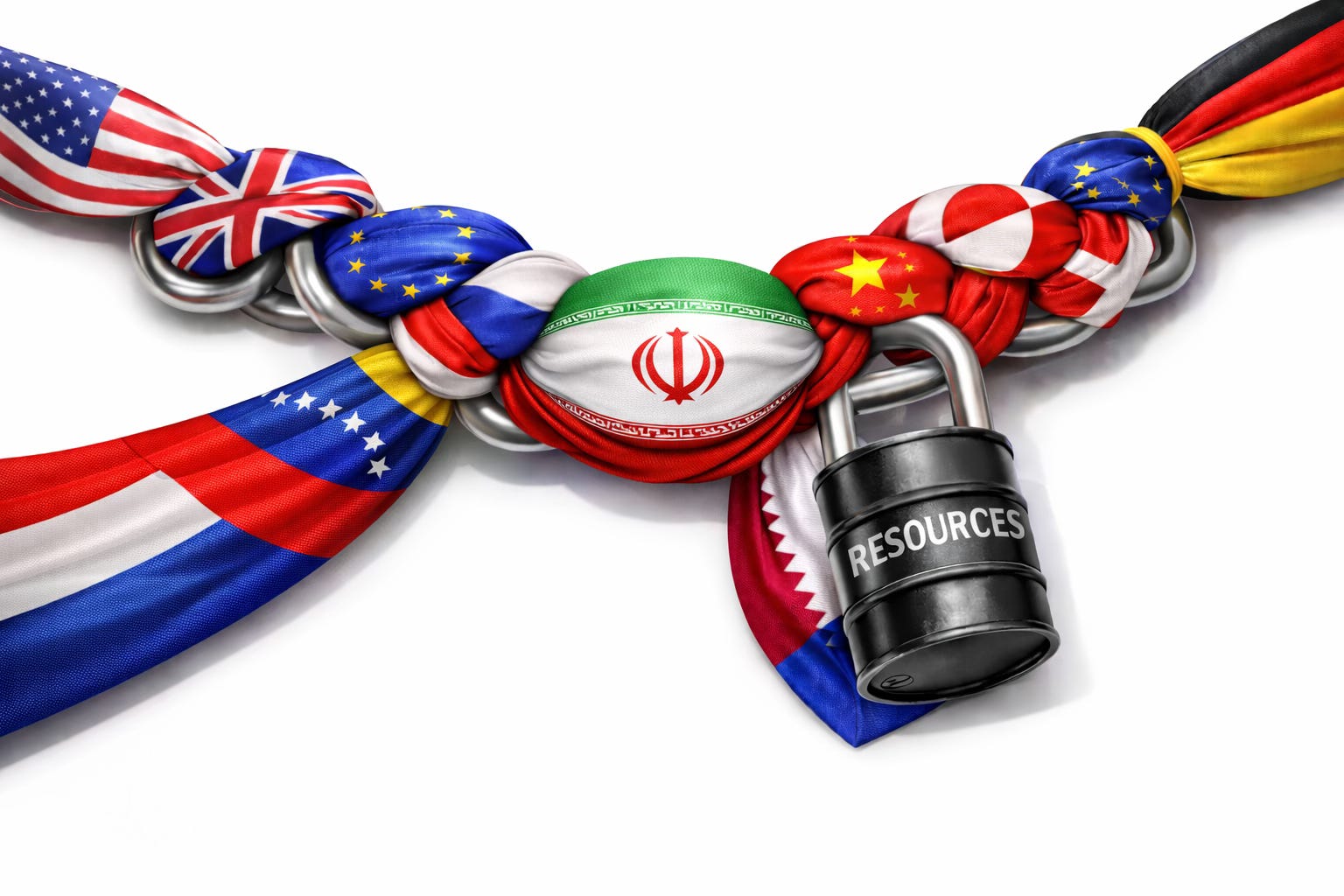
We are living inside the scenario that most analysts considered a tail risk eighteen months ago. In June 2025, the United States struck three Iranian nuclear facilities — Fordow, Natanz, Isfahan — with B-2 bombers and Tomahawk missiles. Operation Midnight Hammer was the first direct American attack on Iranian soil since 1988. The Pentagon assessed it set Iran’s nuclear programme back roughly two years.
It is now February 2026. Iran has spent eight months reconstituting — faster than expected. Two US carrier strike groups are positioned in the region. President Trump gave Tehran a fortnight to submit a credible proposal. Iranian forces closed the Strait of Hormuz for several hours last week during what they called a military drill. Brent crude moved four dollars in ninety minutes.
This is not, at its core, a crisis about nuclear thresholds. It is a contest over who controls the commodity flows, trade corridors, and financial architecture that constitute power in the twenty-first century. Iran sits at the intersection of all of them. As I have argued in my book, The Edge, and throughout this Substack series — from Ukraine’s contested gas fields to Venezuela’s untapped reserves — competition for energy resources is the common denominator beneath the geopolitical conflicts of our time. Iran is the latest, and most dangerous, proving ground.
And if a second strike comes, the economic shock will not be distributed evenly. It is likely that Europe and the United Kingdom will absorb it hardest outside the Gulf region itself. That asymmetry is not being discussed with anything approaching the seriousness it deserves.
Why Now? The Confluence of Timing
The surface triggers are well documented: Iran’s rapid reconstitution of enrichment capacity, its stockpile approaching weapons-relevant quantities, the hardening of nuclear sites, concealment from IAEA inspectors and lethal quashing of protests. But military timing is most often determined by the intersection of capability, domestic politics, and strategic opportunity — and all three have aligned.
Trump’s second term has more than two years of runway. Action taken now can be positioned, ahead of mid-term elections and notwithstanding his domestic agonistes with the Supreme Court over tariffs, with ICE and with the Epstein files, as decisive deterrence rather than desperate distraction. The Iranian regime is internally weakened. Nationwide protests have swept all 31 provinces since December 2025. The economy is in severe distress: currency collapse, inflation at politically destabilising rates, sanctions-constrained oil exports. The regime has arrested and executed thousands. US and Israeli planners are reading this not as political noise but as structural fracture — a window in which Iran’s capacity to absorb escalation is meaningfully reduced.
Meanwhile, satellite imagery shows reconstruction at speed — including concealed underground facilities at Natanz and a completed concrete sarcophagus at Parchin. The intelligence community’s confidence in its visibility into the programme is eroding. Once that visibility is gone, the option to strike with precision may go with it.
And energy markets are, in a brief window, probably able to absorb it. The US has rebuilt its Strategic Petroleum Reserve. Saudi Arabia retains meaningful spare capacity. A strike before oil demand seasonally peaks in summer offers the best macro cushion available. Paradoxically, this makes the window finite: delay into a tighter market raises the economic cost materially.
There is a further dimension. The trade confrontation between Washington and Beijing has intensified sharply. Iran is the discount oil supplier that cushions China’s industrial cost base. A strike that disrupts Iranian exports is also covert pressure on Chinese economic resilience — without requiring a direct tariff or financial sanction. The strategic logic is elegant, if dangerous.
The Resource Chessboard
Step back from the tactical picture and the strategic geometry becomes clearer. As I traced in The Edge, the United States is simultaneously engaged across multiple theatres of resource competition, and Iran connects into each one.
Ukraine is largely about gas transit, grain, Black Sea access, and the credibility of NATO’s deterrent architecture. I wrote about this in my Substack ‘On the Edge’, explaining how Donbas sits at the junction of contested energy flows and industrial resources. Greenland has moved from geopolitical curiosity to active acquisition target — with Russia claiming 1.2 million square kilometres of Arctic seabed beneath the Lomonosov Ridge through its UNCLOS submission, including an estimated five billion metric tons of fuel equivalent, in direct competition with Denmark - through Greenland - and Canada. The Arctic is a resource frontier where rare earth minerals, vast gas reserves, and shipping routes are being contested by the same powers competing in the Gulf. Venezuela, as I explored in my last Substack, sits atop the world’s largest proven oil reserves, entangled with Chinese financing and Iranian operational support. Russia remains a commodities superpower that has demonstrated its willingness to weaponise supply.
China is the gravitational centre of the entire equation. It dominates rare earth processing and the global renewable energy industrial complex — manufacturing over 80% of the world’s solar panels, 60% of its wind turbines, and over 70% of every major clean technology component from batteries to grid equipment, while lodging 75% of global clean energy patent applications. It is the largest incremental crude importer, and is systematically building parallel payment systems designed to reduce dollar dependence. It purchases the majority of Iranian oil exports — discounted barrels that subsidise its industrial energy cost base.
Iran links all of this. A strike on Iran is not a Middle Eastern event. It is a signal read simultaneously by Moscow, Beijing, Caracas, and the Gulf states.
Where the Shock Lands
Roughly a fifth of globally traded oil passes through the Strait of Hormuz. When Iran closed it for several hours last week, Brent crude moved four dollars on no physical disruption — purely on signal. A persistent higher oil price does not stay in the energy sector. It feeds into inflation expectations, bond yields, FX volatility, and equity risk premia. It reshapes central bank trajectories. It alters election outcomes.
The commodity cascades are tiered. A contained strike with no Hormuz disruption adds $10 to $12 to Brent, putting it in the low-to-mid $80s. Iranian infrastructure strikes push prices toward $100. A sustained harassment campaign — the most likely asymmetric response — could keep Brent above $90 for months.
But crude oil is not the most underpriced risk. Qatar is the world’s largest LNG exporter. Qatari LNG transits Hormuz. If Iranian retaliation targets Gulf energy infrastructure, European and Asian LNG markets reprice violently. Europe replaced Russian pipeline gas largely with LNG — American and Qatari — and has limited alternatives at speed. As of mid-February 2026, EU gas storage has fallen to around 33% of capacity, well below the ten-year average of 50–58% and the lowest level at this point in the year since the run-up to Russia’s invasion of Ukraine. Germany is at 30%, France at 29%, the Netherlands at 24%. The UK holds roughly twelve days’ supply. A Qatari LNG disruption would be the more structurally damaging shock — and the one that brings the argument in this Substack series full circle.
It would also substantially increase European dependence on American LNG. The United States already accounts for 57% of total EU LNG imports, up from 45% in 2024, and US export capacity is set to double by the end of the decade. A Qatari supply shock would accelerate long-term contracting with US producers and could push America’s share of European LNG toward 70% or higher. The irony is pointed: the US takes military action that disrupts a critical European supply source, and the replacement supplier is the country that created the disruption. Washington benefits from the crisis three times — as the military actor, as the safe-haven currency beneficiary, and as the alternative energy supplier.
There is also the financial architecture to consider. Sanctions regimes are not political statements — they are financial sieges. Dollar clearing, SWIFT access, insurance markets, shipping finance — these are instruments of statecraft as precise as any munition. Iran has spent a decade building workarounds: shadow fleets, alternative settlement mechanisms, opaque commodity trading structures. A further strike risks accelerating the drift away from the Western financial core. Energy exporters may deepen non-dollar settlement arrangements. China will expand CIPS usage. None of this dethrones the dollar overnight, but the trajectory matters. Each crisis incrementally reshapes the plumbing of global finance, and plumbing, once relaid, tends to stay relaid.
The United States is a net energy exporter. An oil price spike is, in aggregate, a terms of trade gain or windfall for the American economy. The US is a shock exporter.
Europe and the United Kingdom are shock absorbers. The EU imports over 95% of its oil and around 90% of its gas. The UK is structurally a net importer and increasingly so — 44% of total energy was imported in 2024, up from 40% the year before, with North Sea production at record lows and forecast to halve by 2030. Higher prices are an unambiguous terms of trade loss — money leaves the economy and does not return through domestic production revenues.
European industry was fighting an energy cost war before this crisis. German industrial electricity prices remain two to three times higher than US equivalents. The chemicals, steel, aluminium, and ceramics sectors have been quietly hollowing out. The Draghi report identified this as the central threat to European economic viability.
The UK has its own version: North Sea production in decline, industrial energy costs elevated, a government committed to a 2030 clean power target that has not yet closed the reliability gap, and virtually no fiscal headroom. Germany is in technical recession. France has a minority government. The fiscal buffers that would be needed to absorb another 2022-style crisis simply do not exist.
And the currency asymmetry makes it worse. In a geopolitical shock, the dollar strengthens. For Europe and the UK, dollar-denominated commodity prices become more expensive precisely when the dollar appreciates against the euro and sterling. Europe gets hit twice: the commodity price rises, and the exchange rate amplifies the pain.
Energy costs are the most direct link between geopolitics and household politics. European electorates demonstrated in 2022, 2023, and 2024 that energy bill shock translates rapidly into political instability and governments falling. Another oil shock in 2026 would land on populations that have not recovered psychologically or financially from 2022. Governments across Europe know this. Which is precisely why none of them are saying it publicly.
The Root Cause — and What We Can Do About It
This is the point at which the story I have been telling since my first Substack — and throughout The Edge — becomes not merely relevant but urgent. Everything described above relates, at root, to dependence on centralised, distant, contested sources of energy. The Strait of Hormuz matters because the world built an energy system that requires vast quantities of hydrocarbons to travel thousands of miles from extraction to combustion. Russia can weaponise gas because Europe became dependent on pipelines stretching from Siberia.
But dependence on distant fuel is only part of the problem. As I have set out in ‘A Perfect Problem’, ‘Blowing Hot Air’, ‘Reality Strikes Back’, and other Substacks in this series, the energy system’s deepest flaw is its extraordinary inefficiency. Roughly three quarters of the world’s primary energy is lost before it reaches the point of use — most of it as waste heat in centralised generation, but also in extraction, conversion, transmission, and distribution. And then more is wasted when it gets there, through sub-optimal equipment, poor insulation, and inadequate controls. In the United States, less than 40% of primary energy supply produces useful work or heat. About 50% of the world’s primary energy is wasted in the generation process alone — literally as hot air.
This is what I call ‘probably the biggest, dirtiest secret of the energy sector’. Despite trillions invested in renewables, fossil fuels still represent over 80% of primary energy and emissions keep rising. We have been fighting a war on climate change and energy insecurity with tactics — more centralised generating capacity, longer transmission lines — rather than strategy. And that strategic failure is directly connected to the geopolitical vulnerabilities playing out in the Gulf. Every unit of energy wasted is – compounded by the inefficiency of the system - two units or more that must be produced, transported, and competed for. Reduce the waste, and you reduce the exposure — to price shocks, to supply disruptions, to the political leverage of hostile states, and to the carbon emissions that are heating the planet.
The solution is not abstract. It exists today, at commercial scale, using proven technologies. It is what I call Edge infrastructure: efficient, decentralised energy generation deployed close to or at the point of use. This means on-site renewables, combined heat and power, heat recovery, thermal and electrical storage, waste gas recycling, and intelligent building controls — the portfolio of technologies that SDCL builds, owns, and operates across more than 50,000 sites globally.
Edge infrastructure addresses each of the vulnerabilities exposed by the Iran crisis simultaneously.
It reduces cost exposure. When energy is generated at the point of use, the enormous losses from centralised generation and long-distance transmission are eliminated. Fixed-price, long-term energy service contracts insulate businesses and institutions from spot market volatility — precisely the volatility that a Hormuz disruption creates. As I have long maintained: if it’s not commercial, it’s not sustainable. Edge infrastructure makes commercial sense because it saves energy and therefore reduces cost.
It strengthens energy security and resilience. Decentralised generation does not depend on a single pipeline from Russia, a single strait in the Gulf, or a single grid connection that can be overwhelmed. It diversifies sources, shortens supply chains, and reduces the attack surface of the energy system. When every building, factory, and campus can generate and store its own energy, the system becomes inherently more resilient — not through redundancy but through architecture.
And it protects the environment. Efficiency is the fastest, cheapest route to emissions reduction. The International Energy Agency has proposed that a doubling of the rate of energy efficiency could deliver half of all cumulative greenhouse gas emission reductions by 2030. Every unit of energy not wasted is two units of fossil fuel not burned, carbon not emitted, resource not competed for. Edge infrastructure does not merely mitigate the symptoms of the energy system’s failures. It addresses the root cause.
For those building and investing in this infrastructure, the lesson of this moment is structural, not cyclical. Higher fossil fuel price volatility strengthens the economic case for electrification, distributed generation, storage, and resilient architecture. Assets that deliver reliable, clean energy under long-term contract — the infrastructure that SDCL builds and owns — are not a defensive allocation. Capital does not rotate away from energy in a crisis like this. It rotates within it — toward the assets that insulate their owners from exactly the kind of shock that is now playing out. If volatility becomes the baseline condition — which is the direction of travel — resilience becomes the premium.
Standing on The Edge
The rationale for a further strike on Iran, viewed coldly, is about the credibility of deterrence: preventing Iran from recovering a nuclear threshold, constraining regional destabilisation, and signalling American resolve at a moment when it is being tested on multiple fronts — Ukraine, Taiwan, the South China Sea, Venezuela, at home. The risk is that the economic second-order effects become the primary story.
In a world contending with high debt, fragile growth, incomplete energy transitions, and political polarisation across the Western democracies, energy shock is the most efficient transmission mechanism from geopolitics to domestic instability. Europe and the UK are not bystanders to that transmission — they are the most exposed point on the circuit. The United States must weigh not only military outcomes but capital market consequences, and in particular the consequences for its allies, whose political stability is not incidental to American strategy but central to it. A strike that succeeds militarily but triggers a sustained Hormuz disruption, an oil price spike, accelerated non-dollar energy settlement, and a fresh wave of European populist politics is not an unambiguous victory. It is a Pyrrhic outcome dressed as deterrence.
What makes this moment different is the simultaneity of pressures: a nuclear programme reconstituting faster than predicted; a regime internally weakened but externally defiant; an energy market balanced between cushion and shock; a China relationship that has crossed from managed competition into structural confrontation; a European economy that cannot absorb another energy shock without political fracture; and a global financial architecture that is quietly bifurcating, one crisis at a time. In 2026, power is not measured in missiles and carrier groups alone. It is measured in supply chains, commodity flows, bond yields, and currency confidence — and in whether your allies can absorb the cost of your decisions.
The question is not whether markets can absorb another shock. They can. The question is how many structural shocks the system can endure before volatility becomes the baseline condition — the new operating environment rather than the deviation from it. And which economies, and which governments, run out of cushion first.
The answer to that question, right now, has a European postcode.
But this does not need to be a doom loop. The greatest untapped resource the world has is the energy it is wasting. The competition for resources that I describe in The Edge — that drives conflicts from Donbas to the Strait of Hormuz — can be reduced, structurally and permanently, by needing less of the resource being competed for. As I noted in my Substack ‘Make Stuff Not War’, Sun Tzu wrote that ‘the supreme art of war is to subdue the enemy without fighting.’ Efficient, decentralised energy will not prevent the next crisis in the Gulf. But it can, over time, reduce the leverage that contested energy chokepoints have over the economies and the populations that depend on them. It addresses costs, security, resilience, and emissions simultaneously — not through subsidy or ideology, but through commercial logic.
That is the edge. We are standing on it. But we have the tools to step back.
Jonathan Maxwell is the CEO of Sustainable Development Capital LLP and author of The Edge. He writes about energy, climate, finance, and geopolitics.
Views expressed are personal and do not constitute investment advice.