
A Very British Problem
We are world-class at talking about the weather. It’s time we got world-class at doing something about it. Call it Britpower.

As I write this, Britain is doing the two things it does best in a heatwave: melting, and talking about it. Schools are shut. Trains are crawling under speed restrictions to stop the rails from buckling. Offices are sweltering because no one can open the windows. And up and down the country, the nation is engaged in its favourite participation sport — discussing the weather.
The weather is the most reliably British subject there is. Preparing for it is not.
That is the very British problem. And the deeper irony is that it cuts both ways.
A problem built into our bricks
We are a country built for cold. Our homes, offices and hospitals were designed to trap heat, not shed it — which is precisely why, when the mercury climbs, the whole system runs slow and hot. For most of the year we sit below the temperature band at which people are most comfortable and most productive. That is why cold, not heat, remains our biggest temperature-related killer: tens of thousands of excess deaths every winter, against heat deaths still measured in the hundreds to low thousands — though those are now climbing fast as summers intensify.
Put a number on the “inconvenience” and it looks expensive. A University of Oxford study published in The Lancet Planetary Health estimates that days of unusual cold or heat account for around 3% of NHS England’s primary and secondary care costs — roughly £3 billion a year, of which about two-thirds is driven by cold. The Office for National Statistics, separately, estimates that hot days have cost the economy an average of £1.2 billion a year in lost productivity, with £5.3 billion lost in the worst single year. Behind those headline figures sit damaged infrastructure, disrupted transport, lost harvests, and an NHS that takes a hit at both ends of the thermometer.
Here is the uncomfortable part: from a national political point of view, we have no real plan for any of it. The government’s own Climate Change Committee has criticised the absence of an overarching strategy for managing heat risk; researchers have been calling for a National Heat Risk Strategy for years. We are, in other words, improvising — running a well-meaning campaign that comes and goes with the weather.
“But we’re less than 1%”
Whenever I make this argument, someone reaches for the great British excuse: Britain is less than 1% of global emissions and energy use — so what’s the point?
Let me fact-check my own side first, because honesty matters. The number is roughly right. On a territorial basis the UK is responsible for around 1% of the world’s CO₂ emissions today, and consumes about 1% of the world’s energy.
But the conclusion is nonsense, for three reasons.
First, we are not innocent bystanders to the carbon already in the atmosphere. Cumulatively, Britain has emitted something like 3% of all the CO₂ humanity has ever produced — a wildly outsized share for a country our size, because we went first.
Second, that “1%” flatters us. Once you count the emissions embedded in everything we import and fly, the average Briton’s footprint is roughly double the world average.
Third — and most importantly — adaptation has almost nothing to do with our 1% of emissions. Making our own buildings, grids and transport resilient protects our own people and our own economy regardless of what anyone else does. The “too small to matter” argument, followed to its logical end, is an instruction for every country on Earth to do nothing. It is paralysis dressed up as realism.
We have done this before
And it ignores our actual history. Britain spent two hundred years exporting the Industrial Revolution — the steam, the steel, the railways, the financial plumbing that built the modern world. We carry that 3% of historic carbon precisely because we led. So the question is not whether a country of our size can move the needle. It is whether we choose to lead the next infrastructure revolution the way we led the last one — and capture the prize for doing so.
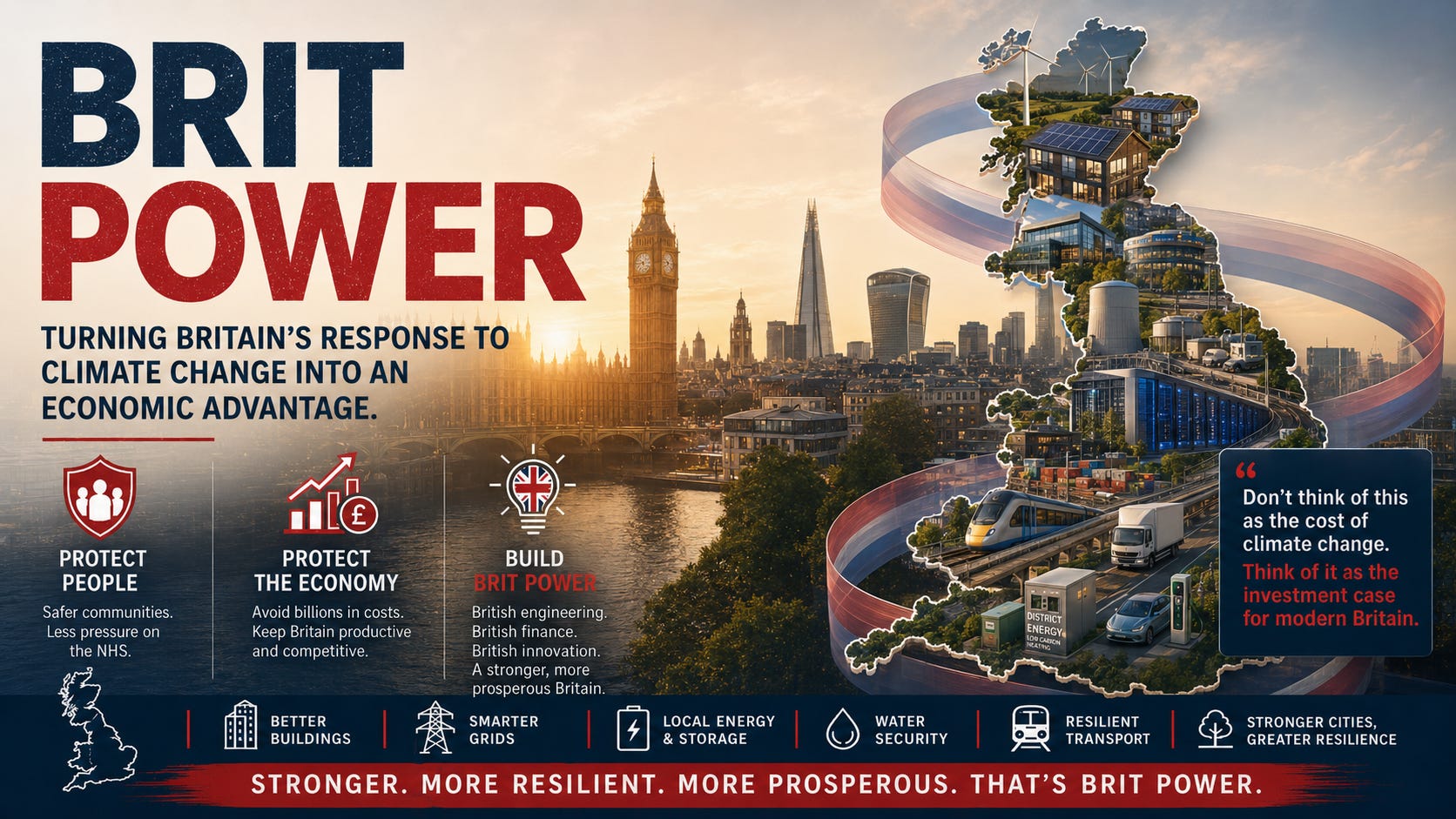
That prize is the part the doom-mongers always miss. Most people see climate adaptation as a cost. I see one of the largest investment needs and opportunities of the next thirty years. Better buildings (that save money). Modern grids (that enable more work). Local generation and storage (that are more efficient). Resilient transport. Smarter cities. These are exactly the long-dated, cash-generative infrastructure assets that Britain has financed and built well for generations. Done right, adapting doesn’t only protect us. It makes us more productive, more energy-secure, and a more attractive place to invest. And then we export the capability.
I call it Britpower.
What Britpower means
Britpower is simple. It means using British engineering, British finance, British innovation and British institutions to make this country more resilient, more energy-secure and more prosperous — and then selling that capability to a world that needs exactly the same thing.
Its engine is the argument I made in The Edge and return to most weeks in this Briefing: efficiency first, and generation close to where energy is used. The cheapest, cleanest, most secure megawatt is the one you never have to generate because you didn’t waste it. The next cheapest is the one you generate on the roof or behind the meter — the megawatt that doesn’t depend on a shipping lane staying open, a government staying in office, or a transmission line getting built on time.
What lifts this above a slogan is that the same intervention solves several British problems at once. A well-insulated, efficiently-powered, locally-generating building stays warm in the winter that kills and cool in the summer that costs — and it runs cheaper all year. The measure that protects a pensioner in January is the measure that keeps a hospital running in July. You don’t have to choose between the cold problem and the heat problem. You solve both with the same pound.
The instruments already exist
And here is the genuinely hopeful bit: we don’t need to invent the machinery. It is already here. The job is to point it at the right target — efficient, decentralised, resilient infrastructure at the point of use — and to crowd in the private capital and engineering talent to scale it.
• The London EDGE Fund, which my firm manages in partnership with the Mayor of London, exists to develop and invest in profitable energy-efficiency and local-generation projects across the capital. The principle is the one I wrote about when the winter fuel allowance was cut: we waste most of the energy in the system, and fixing that is both an act of compassion and a commercial opportunity.
• The National Wealth Fund now holds £27.8 billion of public capital, with an explicit mandate to “crowd in” several pounds of private money for every public pound. It is already backing grid upgrades, ports and — tellingly — building retrofit. Pointed hard at efficiency and decentralised generation, it could be a serious lever.
• Great British Energy has put up to £1 billion behind a Local Power Plan for community and locally-owned clean energy, and £255 million is already putting solar on hundreds of schools, NHS sites and military estates — generation close to demand, exactly where it belongs.
None of these is perfect, and all of them are young. But the raw materials — public catalytic capital, one of the deepest pools of private infrastructure finance in the world here in the City, and some of the best engineers and project developers anywhere — are sitting right here. What is missing is the strategy to aim them.
The proof is in the queue
If you want evidence that the centralised, supply-side model has run out of road, look at the connection queue. Britain has something like 125 gigawatts of projects waiting to plug into the grid — perhaps 50GW of it data centres, the basic infrastructure of the AI economy we keep saying we want to win. You cannot build wires fast enough to clear that backlog, and the regulator has all but admitted it.
But you do not wait years for a grid connection if you generate and manage your power onsite. Decentralised, efficient infrastructure is not only how we keep pensioners warm and hospitals cool. It is how we plug in the industries that will pay for everything else. Resilience and growth, it turns out, are the same project.
Bring leadership back to the table
I have argued the cold side of this before. When the winter fuel allowance was cut, I wrote that the real tragedy was not the headline — it was that we waste most of the energy in the system while passing the pain to the most vulnerable. This heatwave is the same argument arriving from the opposite direction. Energy has become so central to our security and our cost of living that it can now topple governments. The answer is not to wait for the next crisis, the next minister, or the next hot week. The answer is structural, it is commercial, and it is available now.
Business and leadership are, in the end, about solving problems. We have a very British problem. We also have — sitting in our commercial, industrial and technology toolbox, on our balance sheets, and inside our institutions — a very British solution. It is time to bring business and leadership back to the table, and build it.
Call it Britpower.
Jonathan Maxwell is the CEO of Sustainable Development Capital LLP and author of The Edge. He writes about energy, climate, finance, and geopolitics.
Views expressed are personal and do not constitute investment advice.
To learn more about energy efficiency, visit the website of SEIT plc, or SDCL Group.